
By Jordan Dalladay and Craig Wright | UN/DO
Artificial intelligence is becoming extraordinarily capable. Models can generate analysis, write code, explore strategic options, produce recommendations and increasingly take action on our behalf. Yet an organisation can have access to powerful AI, successfully integrate it into its systems, achieve widespread adoption and demonstrate significant productivity gains without seeing a corresponding improvement in its ability to deliver meaningful outcomes.
The technology works, but the organisation doesn't necessarily move.
The Last Mile of AI is the organisational challenge of turning available intelligence into meaningful outcomes. It encompasses the interpretation, judgement, decision-making, coordination, action and learning through which AI capability becomes consequential. Unlike narrower definitions focused on implementation, integration or adoption, the Last Mile concerns whether the organisation itself becomes more effective.
It's the subject of our book, The Last Mile of AI: What happens when intelligence is no longer scarce? And we think understanding it requires looking considerably further than the technology itself.
The phrase last mile of AI is increasingly used to describe the difficulties of getting artificial intelligence into production. Depending on who is using it, the last mile might mean prompt engineering, connecting AI to proprietary data, integrating models into enterprise systems, designing usable interfaces, establishing governance or persuading employees to adopt new tools.
These are real challenges, and in many organisations they remain substantial barriers to realising value from AI. But we think this interpretation stops too early. Getting AI to work reliably within an organisation is not the same as making that organisation more effective.
An AI system can be technically capable, well-integrated, accessible, trusted and widely used, yet still fail to change the outcome it was meant to improve. That distinction matters because it changes where we look for the problem, what we measure as success and what kinds of intervention we consider.
To make it clearer, we distinguish between three different territories.
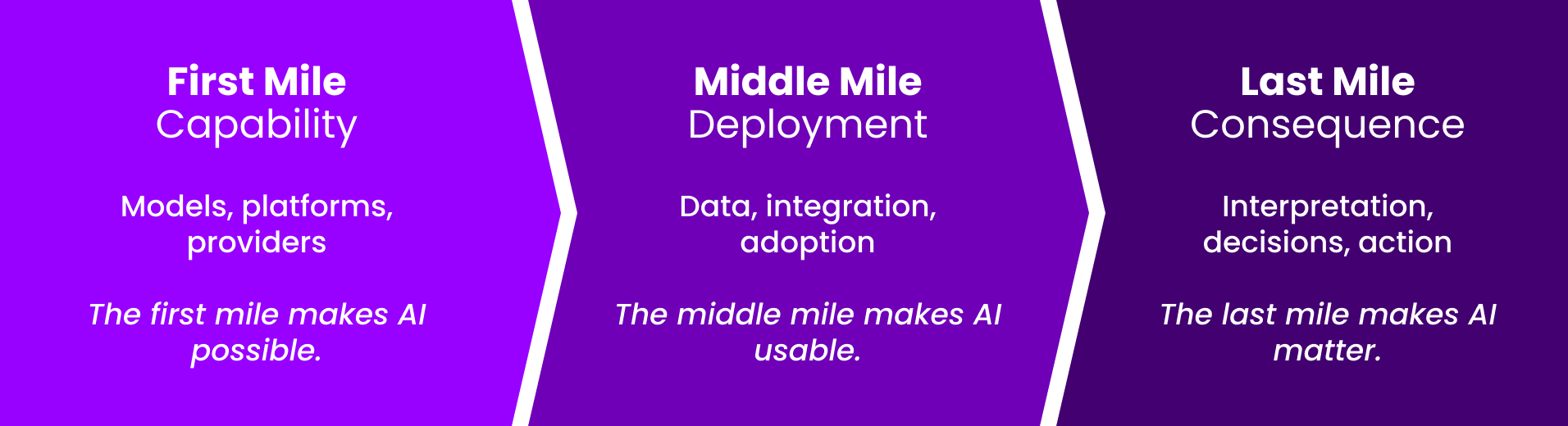
The First Mile makes AI possible.
This is the world of models, platforms and the providers developing the underlying technology. The central questions concern what AI can do, how reliably it can do it and at what cost. Can a model reason through a difficult problem? Can it generate accurate analysis, write useful code, interpret complex information or perform increasingly sophisticated tasks?
This is where much of the AI industry's most visible progress takes place. Capabilities improve, costs fall, new possibilities emerge and the boundary of what can be automated or augmented continues to move. The First Mile determines what is technologically possible.
The Middle Mile makes AI usable.
This is the work of turning general technological capability into something that operates reliably within a particular organisational context. It includes connecting systems to enterprise data, developing applications and agents, designing prompts and workflows, building interfaces, establishing permissions, ensuring security, supporting adoption and embedding AI into everyday work.
It is where organisations translate technological possibility into operational capability. A model may be extraordinarily capable, but without appropriate context, reliable data, integration and usable experiences, that capability may remain inaccessible or ineffective.
The Middle Mile matters enormously. But an organisation can successfully cross it and still be left with the most consequential question: what actually changes because the intelligence is now available?
The Last Mile makes AI matter.
The Last Mile concerns what happens when intelligence enters the wider system of organisational judgement, decision-making, coordination, action and learning. It asks whether new intelligence changes what an organisation can accomplish, rather than simply how efficiently particular activities can be performed.
This brings into view questions that cannot always be resolved through better models, stronger integrations or more effective adoption. Who decides what matters, and how are competing recommendations judged? Where does authority sit, and what incentives shape whether people act? How do decisions travel across organisational boundaries? What happens when an AI system identifies an opportunity that existing commercial or operational arrangements cannot accommodate? And how does the organisation learn from the consequences of its actions?
These questions are not peripheral to AI value. They help determine whether the value materialises at all, and crucially, they are not necessarily questions that arise only after deployment.
The Last Mile can begin before anyone builds a system, with how the problem is framed and what outcome is worth pursuing. It continues through the decisions, actions and learning that follow. It is less a final implementation step than an ongoing organisational challenge.
Consider an organisation that uses AI to transform its research and analysis capabilities. Work that previously took eight days can now be completed in two. That's a substantial improvement: the team has become much more efficient, can respond faster, investigate more options and produce more analysis with fewer resources.
But suppose the decision supported by that analysis still takes four weeks. The research is faster, but the outcome has barely moved.
The problem isn't that the AI has failed. It has done precisely what was expected of it. The problem is that the analysis was only one part of a wider system, in which the recommendation still needs to be interpreted, weighed against other priorities, reviewed by the right people, reconciled with competing interests, funded and translated into action. The AI has accelerated one activity without necessarily accelerating the process through which the organisation produces outcomes.
We distinguish between two forms of productivity. Task productivity describes how efficiently a bounded activity is completed, while outcome throughput describes how effectively the wider system converts connected activities into results that matter.
Improving the first does not guarantee improvement in the second. Sometimes a faster activity removes the genuine constraint, releasing capacity and accelerating the outcome. But sometimes the organisation simply produces work faster than it can absorb it. More recommendations require more judgement, more options compete for executive attention and more outputs need reviewing, integrating or challenging. Work that disappears from one person's schedule can reappear in somebody else's.
This also changes the economics of intelligence. As AI makes outputs cheaper to generate, the costs of interpreting, evaluating and acting upon them can become more consequential. We explore this through Intelonomics, which examines three interconnected economic layers: the cost of producing intelligence, the cost of absorbing it and the costs and value created by what happens next.
This is why AI productivity and organisational progress must be examined separately. The useful question is not only how much faster a task became, but what changed in the wider system because that task became faster.
There's another reason the Last Mile deserves attention. When AI successfully improves one part of an organisation, the constraint on progress may move somewhere else. We call this constraint migration.
Imagine a renewable energy business deploying AI to improve the monitoring and optimisation of wind and solar assets. The technology works: the organisation gains better visibility into asset performance, while predictive models identify potential failures and recommend interventions that could reduce downtime or improve generation. From a technical perspective, the system is delivering value.
But now imagine that an intervention recommended by the model sits within an existing commercial contract. The manufacturer would bear the cost of replacing a component, while the asset owner would capture most of the financial benefit from avoiding downtime. The model can identify the economically preferable action, yet the parties responsible for making it happen may have no incentive to do so.
The next model doesn't necessarily need to be more intelligent. The commercial arrangement needs to change.
What began as a technical optimisation problem has become a problem of incentives, contracts and organisational coordination. This is the Last Mile, and it reveals something important: successful AI adoption can expose organisational constraints that were previously difficult to see. The technology doesn't always create the problem; sometimes it makes an existing problem more consequential.
As AI capability improves, the question therefore changes. It's no longer simply what we can make the technology do, but what now prevents the organisation from achieving the outcome?
That constraint may still be technical. But it may also lie in judgement, authority, attention, incentives, coordination, commercial design or the organisation's capacity to learn. The point is to follow the constraint rather than assume it remains where the programme began.
The organisational problem isn't always downstream from the AI. Sometimes it begins with the question we've asked it to answer.
One of the consequences of more capable AI is that the distance between an idea and a plausible output is shrinking. A team can turn a loosely framed problem into a detailed strategy, a product specification, a research report or a working prototype remarkably quickly. That can be enormously valuable, but it also introduces a new risk: the answer can arrive before the organisation has adequately understood the question.
A convincing artefact may create the appearance of completed thinking. Assumptions become embedded in polished outputs before they've been examined, and teams can move rapidly towards a solution without discovering whether they are solving the right problem. This is particularly important in ambiguous strategic work, where research, experimentation and development are not simply activities that produce deliverables; they are also how people discover what matters.
Better prompts may improve the quality of an answer, but they cannot, by themselves, establish whether it was the right answer to seek. Similarly, more sophisticated integration may enable an organisation to automate an existing process without challenging whether that process should continue to exist in its current form.
The Last Mile therefore asks us to look upstream as well as downstream. What outcome are we trying to achieve? What assumptions are shaping how we've defined the problem? What do we still need to learn before committing to a solution? And what might become possible if we rethink the work itself rather than simply make it faster?
These questions point towards a larger shift in how we understand AI transformation. We often talk about intelligence as something that resides inside a model, a system or an individual, but organisational intelligence is also shaped by the conditions in which people and technologies operate.
It depends on how relevant information travels, how context is shared, how uncertainty is expressed, how competing perspectives are reconciled, how authority is distributed and how experience becomes collective learning. A technically sophisticated AI system enters an organisation that already has ways of thinking, deciding and acting, and those arrangements shape what the technology can achieve.
An organisation that cannot make timely decisions may simply generate recommendations more quickly. One with conflicting incentives may struggle to act on better predictions, while an organisation with weak learning mechanisms may repeat mistakes at greater speed. And an organisation that rewards the production of outputs rather than meaningful outcomes may become impressively busy without becoming substantially more effective.
This is why we argue that the organisation is part of the intelligence. The value of AI doesn't depend only on the intelligence the technology can produce; it also depends on the surrounding system's ability to interpret, judge, coordinate, act and learn.
This doesn't mean every company needs a new organisational chart or a wholesale restructuring programme. It means the design of the organisation itself must become part of how we think about AI.
As AI systems become capable of taking action rather than merely producing recommendations, it is tempting to believe that the Last Mile will increasingly disappear. Agents can execute tasks, coordinate workflows, interact with systems and reduce the need for human intervention. Some of the friction between intelligence and action can genuinely be removed.
But removing a human hand-off does not necessarily remove the assumptions, incentives or authority structures that surrounded it. An agent can execute a poorly framed objective, optimise a metric that doesn't adequately represent the desired outcome, follow an obsolete rule or accelerate a process that should have been redesigned.
Greater autonomy therefore introduces new questions. What should agents be authorised to do, and how are objectives established and challenged? Where does human judgement remain consequential? How can behaviour be corrected when circumstances change, and who is accountable for actions taken by systems operating at machine speed? How does the organisation learn when more of the work is performed by AI?
As systems become more autonomous, the Last Mile doesn't necessarily disappear. Its constraints change. Some decisions and actions may become easier to automate, while others, especially those concerning objectives, authority, accountability and correction, may become more important.
If the Last Mile is an ongoing organisational challenge, it cannot be solved through a one-off deployment programme alone. Organisations need the capacity to repeatedly understand where value is being lost, identify what currently constrains progress, redesign the conditions around that constraint and learn from what changes.
This leads to a concept we're exploring at UN/DO: cognitive infrastructure.
By cognitive infrastructure, we mean the capabilities, arrangements and conditions through which an organisation produces, shares, judges, coordinates, applies and learns from intelligence. This includes its ways of framing problems, directing attention, preserving context, distributing decision rights, enabling collaboration, governing AI action and correcting itself in response to new evidence.
Some of these capabilities are technological, while others are organisational, social, commercial or cultural. The challenge is to design them together, recognising that improvements in one part of the system can change what becomes limiting elsewhere.
This is a different ambition from simply increasing AI adoption. Adoption asks whether people and systems are using the technology, while cognitive infrastructure asks whether the organisation is becoming better at turning available intelligence into sound judgement, effective action and sustained learning.
What does this mean for leaders trying to realise more value from AI? We suggest starting with the outcome rather than beginning with an inventory of AI use cases. Identify a meaningful organisational result that needs to improve, then follow the work backwards and forwards to understand how that outcome is currently produced.
Examine where time, attention, judgement and coordination are consumed, and identify which constraints are genuinely limiting progress. Some will be technological, where better models, data, interfaces or integrations may make a material difference. Others will sit in the way the organisation operates.
Once an intervention improves the system, look again, because the constraint may have moved. This creates a more adaptive approach to transformation: one based on understanding the actual system, learning through intervention and continually adjusting as capabilities and conditions change.
It also changes what success looks like. The goal is not simply more AI use, more automated tasks or more intelligence generated, but an organisation that can achieve more consequential outcomes and become better at adapting as the world changes.
Artificial intelligence is changing the economics of producing many forms of intelligence. What was once expensive is becoming cheaper, what once required specialised effort can increasingly be done by more people, more quickly, and sometimes by autonomous systems.
But more intelligence doesn't automatically create a more intelligent organisation. The Last Mile of AI is the distance between those two things: between capability and consequence, between an answer being available and an organisation being able to do something meaningful with it.
The First Mile makes AI possible. The Middle Mile makes AI usable. The Last Mile makes AI matter.
As intelligence becomes more abundant, that may be where some of the most important work of organisational transformation begins.
The Last Mile of AI: What happens when intelligence is no longer scarce? is a forthcoming book by Jordan Dalladay and Craig Wright, co-founders of UN/DO, a strategic futures studio.
The book explores a fundamental shift in the economics of intelligence: as AI makes answers easier to produce, the harder questions increasingly concern how organisations frame problems, exercise judgement, coordinate action and learn from consequences.
Coming December 2026.
The Last Mile of AI is more than a single challenge. Explore the interconnected ideas that help explain why intelligence doesn't automatically become progress - and what organisations can do about it.
Collective Fluency - How people with different levels of AI capability can continue to think, judge and learn together - turning individual proficiency into collective intelligence.
Constraint Migration - Why improving one capability often reveals another bottleneck, shifting what limits organisational progress.
Intelonomics - The changing economics of intelligence - from the cost of producing it to the effort of absorbing it and the consequences of acting upon it.
Outcome Throughtput - Why making individual tasks faster doesn't necessarily mean making more progress - and how to measure the outcomes that matter.

