
By Jordan Dalladay and Craig Wright | UN/DO
Artificial intelligence is making many forms of intelligence dramatically cheaper to produce. Research that once took days can be completed in hours, complex analysis can be generated on demand, and organisations can explore far more options without a corresponding increase in the people or resources required to produce them.
From the perspective of technological capability, the economic opportunity is considerable. More intelligence can be generated at lower marginal cost, and work previously constrained by scarce expertise or analytical capacity can increasingly be undertaken by people and systems that could not have performed it before.
But there is a complication. The cost of producing intelligence is not necessarily the same as the cost of making that intelligence useful.
An organisation may save substantial time generating reports, recommendations and strategic proposals, while discovering that the work of interpreting, reviewing, deciding and acting upon them has not become proportionately cheaper. In some cases, producing more intelligence increases the demands placed on the wider organisation.
The technology has changed the economics of generation. It hasn't necessarily changed the economics of consequence.
We call this wider perspective Intelonomics, one of the central ideas explored in our book, The Last Mile of AI.
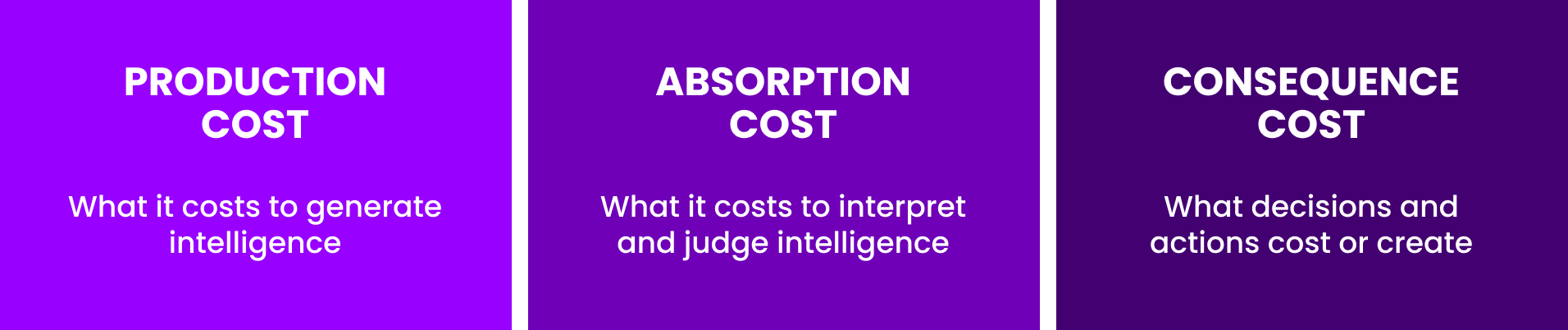
Intelonomics is the study of how the economics of organisations change when useful intelligence becomes dramatically cheaper to produce. It examines not only the cost of generating intelligence, but also what the organisation must spend to absorb it and the economic value or cost created by what happens next.
The central idea is that intelligence has an organisational cost beyond its production. An analysis must be interpreted, a recommendation judged, an option compared with alternatives and a decision translated into action. Those activities require attention, expertise, coordination, authority and resources that do not automatically become abundant as AI improves.
Intelonomics distinguishes three interconnected economic layers:
Production cost is what it takes to generate intelligence, including model and infrastructure costs, licences, human effort and the time required to produce an output.
Absorption cost is what the organisation must expend to interpret, verify, compare, integrate and decide what to do with that intelligence.
Consequence cost is the downstream cost and opportunity cost associated with what happens next, including the investments, risks, actions and alternatives displaced by a decision. Those consequences can also create substantial value through better choices, avoided losses, new opportunities and learning.
These layers help explain why an AI system that is inexpensive to operate may still be economically costly, and why a more expensive system might generate greater organisational value if it reduces the burden of interpretation or enables better decisions.
Intelonomics is not intended as a new accounting standard or a formula that assigns a precise monetary value to every act of judgement. It is a way of widening the economic frame so that organisations can understand more of what AI actually costs and creates.
Consider an organisation that has successfully introduced AI into its strategy development process.
Work that previously took weeks can now be completed in days. Research arrives sooner, initial proposals can be developed more quickly, and teams can explore many more alternatives before making a recommendation.
At first, this looks like an uncomplicated productivity gain. The organisation has reduced the cost of producing strategic intelligence, allowing people to investigate opportunities that might previously have been too expensive or time-consuming to consider.
Then the executive committee starts receiving several substantial proposals every week. Previously, it might have considered only a handful in a quarter.
The organisation can now produce credible options much faster than its leadership can evaluate, fund and execute them. Each additional proposal competes for attention, investment capital and the capacity to act. Even where the individual proposals are worthwhile, they cannot all become priorities.
The economic character of the problem has changed.
When creating a strategic option was expensive, production itself limited supply. As that cost falls, the scarce capability may become choosing which options deserve to become real.
In the book, we describe this paradox simply: each proposal became cheaper, but the portfolio became more expensive.
The technology had genuinely reduced one cost. It had also made other costs more consequential.
Production cost is the most visible part of AI economics. It includes model usage, compute, infrastructure, licences, engineering and the human effort involved in generating analysis, code, reports, forecasts or recommendations.
These costs matter enormously. Falling production costs can make previously uneconomic activities viable, expand access to expertise and create substantial organisational capacity.
A task that once required days of specialist analysis may now be completed in hours. A business can generate more frequent forecasts without proportionately expanding its analytical function. A small team can explore strategic alternatives that previously required a much larger investment.
In some settings, the resulting savings are real and durable. The organisation can complete necessary work at lower cost or undertake valuable work that would otherwise have been impossible.
But production costs describe only the beginning of the economic transaction. Once intelligence has been generated, it enters a wider organisational system.
Absorption cost describes the attention, expertise and organisational effort required to turn generated intelligence into something that can be meaningfully considered or used.
An AI system might generate twenty plausible strategic options at negligible marginal cost. The leadership team still has to understand the assumptions behind them, compare their relative merits, evaluate the evidence, reconcile competing priorities and decide which deserve commitment.
Those activities are not free simply because the options were inexpensive to produce.
The cost may appear as additional meetings, senior review, specialist verification, coordination between functions or the effort required to establish enough shared understanding for a decision to be made.
Absorption costs are often harder to measure than production costs because they are distributed across the organisation. A team may record significant hours saved while the additional demands on reviewers, decision-makers or neighbouring functions remain largely invisible.
This does not mean AI necessarily increases absorption costs. A well-designed system can reduce them by filtering irrelevant information, identifying uncertainty, prioritising important issues or presenting recommendations in ways that support better judgement.
Indeed, reducing absorption cost may sometimes be more valuable than reducing the cost of generation.
The key is to recognise absorption as an economic layer in its own right, rather than assume it disappears when production becomes cheaper.
The third layer concerns what happens when intelligence influences decisions and action.
A recommendation may lead an organisation to commit capital, launch a new product, change a customer experience, alter operational priorities or accept a particular risk. Each action has a cost, but it may also create substantial value.
There is also the opportunity cost of what the organisation does not pursue.
A leadership team cannot fund every credible proposal, and a product organisation cannot build every promising feature. Choosing one initiative means diverting attention, resources and execution capacity from others.
This becomes particularly important when AI makes it much easier to produce convincing options. An organisation may generate hundreds of credible recommendations without materially increasing its ability to act.
The economic cost of a poor decision is therefore not confined to the effort spent producing or evaluating it. It can include the months of execution it consumes, the resources it commits and the better opportunity that never receives attention.
Conversely, intelligence that requires relatively little production or absorption effort may create extraordinary value if it helps the organisation avoid a failure, identify an important opportunity or make a better consequential decision.
Intelonomics therefore asks us to look beyond the apparent efficiency of intelligence production and examine its full organisational effects.
Imagine two AI systems supporting a leadership team.
The first is extremely cheap to operate. It generates twenty plausible options, detailed supporting reports and extensive recommendations. The results are impressive, but several executives must spend time reviewing the material, comparing assumptions and reconciling contradictions.
The second costs more per interaction but understands enough organisational context to eliminate weak options, distinguish evidence from inference and identify the few decisions that genuinely require senior judgement.
On a model-cost dashboard, the first system may look like the better investment. It produces more intelligence for less money.
Economically, however, the second may be considerably more valuable.
It reduces the demands placed on scarce leadership attention and helps the organisation concentrate its judgement on decisions that matter. Rather than maximising the volume of output, it improves the quality and efficiency of the surrounding organisational transaction.
This is an important distinction for the design of enterprise AI.
A system should not necessarily be judged by how much useful-looking material it can produce. Its value may lie in how effectively it reduces unnecessary work, makes uncertainty visible, directs attention or improves decisions.
Sometimes the most economical AI system is the one that produces less.
For much of organisational history, producing useful intelligence was expensive. Analysis took time, expertise was concentrated in particular people, and information-processing capacity limited what organisations could understand and decide.
Many organisational arrangements developed, at least in part, to cope with these conditions. Specialist functions provided scarce expertise, management structures helped distribute decisions, and established processes coordinated the flow of information and authority.
AI is beginning to change some of those underlying economics.
Not every kind of cognition is becoming cheap, and not every task benefits equally. But enough forms of analytical and generative work are becoming faster and more accessible that assumptions about how organisations should produce and distribute intelligence increasingly deserve examination.
When one capability becomes abundant, the relative value of what remains scarce can increase.
If analysis is scarce, producing better analysis is valuable. When analysis becomes abundant, the capacity to distinguish what matters may become more consequential.
If developing strategic options is expensive, generating more alternatives can improve the quality of decision-making. When options become cheap, selecting which opportunities deserve commitment becomes a more important economic question.
If individual production is constrained by specialist capacity, giving people access to AI may create substantial leverage. When individual production accelerates, shared understanding and coordination may become the limiting capabilities.
These shifts are closely related to constraint migration: improving one part of a system changes which other conditions most strongly limit progress.
Intelonomics adds an economic perspective to that mechanism. As scarcity moves, so do costs, opportunity costs and the sources of potential value.
One of the most important scarcities in an AI-enabled organisation is attention.
AI can expand the supply of analysis, options and recommendations much faster than it expands the capacity of people to understand and act upon them.
This creates an important asymmetry. The cost of producing a substantial proposal may fall dramatically, while the cost of deciding whether it deserves investment remains relatively high.
The result can be an organisation in which everybody appears to be saving time except the people responsible for evaluating what the saved time has produced.
The original productivity improvement may still be genuine. The problem is that the resulting intelligence makes new claims on the attention of people whose capacity has not expanded at the same rate.
Attention has an opportunity cost. Time spent evaluating one proposal cannot be spent considering another. An executive reviewing large volumes of AI-generated analysis may have less capacity to engage with customers, develop people or investigate a problem that deserves deeper thought.
These costs rarely appear in AI business cases with the same precision as licence fees or model usage.
Yet they may determine whether an investment creates the value expected of it.
This suggests a different design objective: not simply increasing the supply of useful intelligence, but improving how organisations direct scarce attention towards the work and decisions where it matters most.
Intelonomics is closely connected to the distinction between task productivity and outcome throughput.
Task productivity measures how efficiently a bounded activity is completed. Outcome throughput considers how effectively the wider system converts connected activities into meaningful results.
AI can dramatically improve task productivity without producing a corresponding improvement in outcome throughput. Research may become faster while the decision it supports remains slow. More proposals may be generated without increasing the number of worthwhile initiatives an organisation can execute.
Intelonomics helps explain the economics behind that divergence.
The reduction in production cost may be offset by additional absorption effort, or the resulting intelligence may fail to change the decisions and actions that ultimately determine value.
In some cases, the economic benefit may be substantial even when the outcome doesn't become faster. Better analysis could improve decision quality, reduce risk or allow the organisation to reject an expensive mistake.
The point is not that every AI intervention must accelerate throughput. It is that the economic assessment should extend far enough to capture the outcomes, costs and opportunities that matter.
A complete account of AI value therefore needs to distinguish between making an activity cheaper, making the surrounding system more effective and improving the economic consequences of what that system does.
Intelonomics is most useful when it changes the questions leaders ask about AI investment.
Traditional business cases often begin with the cost of a technology and the expected savings from automating or accelerating particular tasks. These are legitimate starting points, but they can encourage organisations to focus on the activities with the most visible efficiency gains rather than the interventions that would produce the greatest organisational value.
A wider analysis begins with the outcome being pursued.
What needs to improve, and what currently prevents that improvement? Where does the organisation spend effort producing intelligence, where does it spend effort absorbing that intelligence, and what costs or value arise from the decisions and actions that follow?
Consider a strategy function evaluating an AI system for proposal development. The immediate benefit may be a reduction in research and drafting time. But the investment case should also consider whether more proposals will increase demands on executive review, whether better filtering could reduce those demands, and whether the organisation's capacity to select and execute worthwhile opportunities will improve.
The analysis may reveal that the most valuable intervention is not faster proposal generation. It may be a better mechanism for evaluating opportunities, testing assumptions or directing leadership attention towards the few decisions with the greatest potential consequences.
This does not require assigning an exact price to every hour of executive thought or every organisational interaction. Such estimates can create false precision, especially where outcomes are uncertain and interdependent.
It does require widening the boundary of measurement and being explicit about the assumptions connecting the AI capability to the expected result.
The organisation should examine whether an intervention removes work, transfers it elsewhere or changes the quality of consequential decisions. It should then revisit those assumptions once the system is operating, because the effective constraint may have shifted.
Intelonomics is therefore not simply a way of constructing a better business case before deployment. It is a way of continually reassessing where the economics of intelligence now sit.
The Last Mile of AI describes the organisational challenge of turning available intelligence into meaningful outcomes.
The First Mile makes AI possible through technological capability. The Middle Mile makes that capability usable through data, integration, applications and adoption. The Last Mile concerns whether the intelligence becomes consequential through interpretation, judgement, decisions, coordination, action and learning.
Intelonomics helps explain why value can be lost across that wider system.
An AI programme may be technically successful and operationally well-deployed, yet still fail to generate the anticipated economic return because the organisation cannot absorb, evaluate or act upon what the technology produces.
This is not an argument that deployment work is unimportant. Weak integration, unreliable data or inadequate models can remain genuine constraints, and investments in those areas can produce substantial returns.
The Last Mile asks us to follow the economic consequences further, rather than assume that successful deployment is the end of the value story.
Sometimes the next improvement requires better technology. Sometimes it requires different decision rights, stronger coordination, more appropriate incentives or redesigned ways of working.
And sometimes the organisation needs to stop producing additional intelligence and concentrate on making better use of what is already available.
As AI continues to improve, the marginal cost of producing many forms of intelligence will fall. That should make a wide range of activities cheaper and open possibilities that were previously beyond the reach of individuals and organisations.
But the economics of organisations will not necessarily change in proportion to the economics of models.
Judgement, attention, coordination, authority and the capacity to act remain subject to constraints that may not respond to technological improvements in the same way. These conditions shape whether cheaper intelligence produces better outcomes, more organisational work or simply a greater volume of plausible possibilities.
Intelonomics gives us a way to examine those effects by looking at the full transaction: what intelligence costs to produce, what it costs to absorb and what happens economically because of the consequences that follow.
It is not a warning that AI necessarily makes organisations busier or more expensive. AI can reduce costs at all three layers, sometimes dramatically. The question is where those savings and benefits actually arise, and whether the surrounding organisation is capable of realising them.
The price of generating intelligence is not the same as the cost of turning it into consequence.
As intelligence becomes increasingly abundant, that may be one of the most important distinctions for leaders trying to understand the real economics of AI transformation.
The Last Mile of AI: What happens when intelligence is no longer scarce? is a forthcoming book by Jordan Dalladay and Craig Wright, co-founders of UN/DO, a strategic futures studio.
The book explores how the changing economics of intelligence affect organisational performance, why constraints shift as AI capability improves, and what leaders need to rethink to turn technological possibility into meaningful progress.
Coming December 2026.

The Last Mile of AI is more than a single challenge. Explore the interconnected ideas that help explain why intelligence doesn't automatically become progress - and what organisations can do about it.
Collective Fluency - How people with different levels of AI capability can continue to think, judge and learn together - turning individual proficiency into collective intelligence.
Constraint Migration - Why improving one capability often reveals another bottleneck, shifting what limits organisational progress.
Intelonomics - The changing economics of intelligence - from the cost of producing it to the effort of absorbing it and the consequences of acting upon it.
Outcome Throughtput - Why making individual tasks faster doesn't necessarily mean making more progress - and how to measure the outcomes that matter.

